

Lincoln Nonprofit Hopes to Expand Veteran, Homeless Services
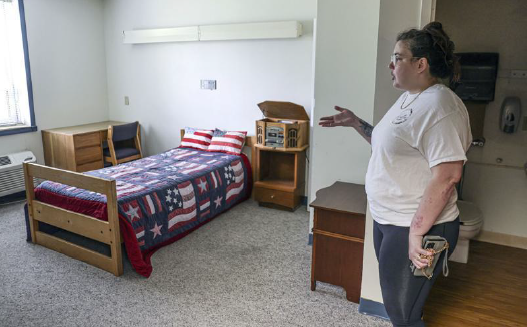
Residence assistant Kristin Ratcliffe shows off a staging bedroom for residents on May 26, 2026, at Hope on 5th, 205 Fifth St. in Lincoln. The organization is a nonprofit and transitional shelter that serves as a one-stop shop, offering emergency, temporary and transitional housing, along with resources to help veterans, families and individuals rebuild their lives.
Reposted from The Pantagraph
Story by Drew Zimmerman, Photos by Clay Jackson
LINCOLN— Since opening its doors in 2024, Hope on 5th has used the former St. Clara’s Manor nursing facility on 200 Fifth St. to provide housing and supportive services to roughly 50 veterans and unhoused residents in Lincoln.
In addition to a furnished room, residents may also receive onsite substance abuse treatment, legal aid services, mental health counseling courtesy of the Springfield Veterans Center, peer support groups and daily recovery meetings.
However, several issues have prevented the nonprofit from fully utilizing the space.
Although the building included a commercial kitchen that’s available for lease, Hope on 5th lacks the staffing to provide food service. Plumbing issues also prevent one wing of the facility from being used for additional housing.
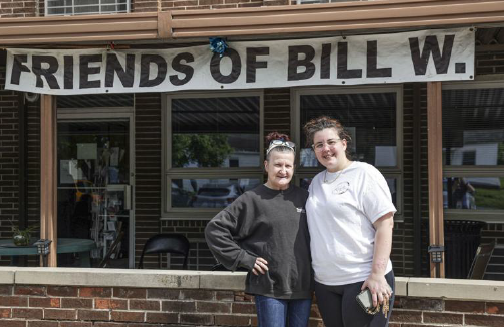
Residence assistant Kristin Ratcliffe, right, poses with resident Trisha Strange at Hope on 5th, 205 Fifth St., Lincoln.
Kim Turner, board chair for Hope on 5th, said the organization is trying to raise money for these repairs, but she has been encouraged by the community outreach that made such a variety of support services possible.
“We’ve been really lucky,” Turner said.
Diane Zosky, emeritus professor from Illinois State University’s School of Social Work, said during a forum on innovative housing solutions earlier this year that Hope on 5th is the Lincoln community’s first regional housing and supportive service for veterans and unhoused residents.
“Its mission is to promote community welfare and to provide shelter and services to Central Illinois veterans, the homeless and those at the risk of homelessness through offering supportive services and housing on an emergency, temporary, transitional and permanent basis,” Zosky said.
Turner said Lincoln College had approached one of Hope on 5th’s veteran advocates in 2022 about donating the building for this purpose.
“They offered it to him because they knew that he was looking for Central Illinois housing for veterans so that veterans wouldn’t have to go so far away for those options,” Turner said.
Without such an opportunity in Lincoln, area veterans could have to travel to Bloomington, Springfield or Peoria to receive specialized services and housing opportunities.
Because Hope on 5th did not have its own board at the time, the property was donated to the Central Illinois Veterans Commission by Lincoln College until such a time that the nonprofit could take charge.
However, stakeholders eventually decided that Hope on 5th should serve all of the city’s unhoused residents.
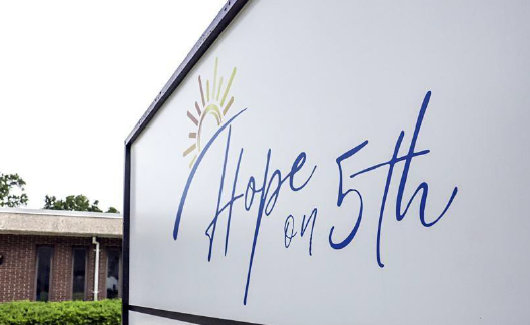
Hope on 5th, at 205 Fifth St. in Lincoln, is a nonprofit and transitional shelter that serves as a one-stop shop, offering emergency, temporary and transitional housing, along with resources to help veterans, families and individuals rebuild their lives.
Since Lincoln College had acquired the building to provide student housing, Turner said every room of the building had its own furnishings and linens, which cut down on costs.
Logan County initially offered $200,000 to help with building renovations but authorized another $100,000 to build out a treatment center space for Trillium Place, a Carle Health affiliate that offers addiction recovery and mental health services.
The Illinois Department of Veterans Affairs awarded Hope on 5th with another $100,000 in grant funding for HVAC and plumbing repairs.
Illinois Prairie Community Foundation’s Women to Women Giving Circle awarded Hope on 5th a $15,000 grant in 2026 to assist with the project.
Hope on 5th’s first client arrived in August 2024 and within three months, it was handing 20 clients. However, the board chose to take a cautious approach to its growth and decided to cap the number of clients.
“None of us knew how to run a shelter – that wasn’t our job,” Turner said. “We know how to refer to a shelter, we know that we have clientele that need shelter, but we didn’t know how to run a shelter so it’s been a learning curve.”
Since then, there has always been a waiting list of potential clients.
Turner said Hope on 5th’s success is thanks to numerous community partners, including Lincoln Memorial Hospital, Community Action Partnership of Central Illinois and the Salvation Army.
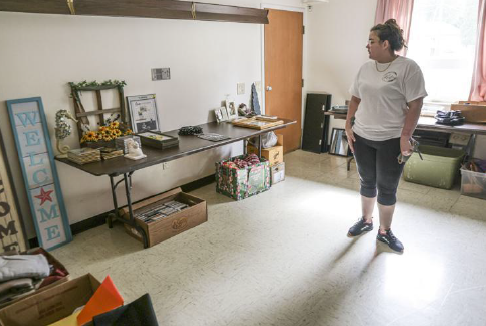
Residence assistant Kristin Ratcliffe shows off a staging room for residents on May 26, 2026, at Hope on 5th in Lincoln.
Although meal services aren’t available, each unit contains a mini-fridge and microwave.
One of the churches that partners with Hope on 5th provides a monthly meal to residents and the Lincoln Logan Food Pantry also delivers food.
Additional cookware, such as crockpots, air fryers and coffee makers, are also available.
Nursing homes have offered wheelchairs, medical equipment and other resources. Strollers and cradles are also available for residents who may have young children.
After the consolidation of one of Heartland Bank’s branches, the bank donated furniture for office space that would be available for lease.
In addition to treatment and counseling services, Turner said the facility also offers life skills, including a computer literacy class.
There have also been offers to provide recreational activities such as yoga. CreatiVets, an art program from Heartland Community College that gives veterans a creative outlet while sharing stories with fellow service members, will also be offered in the basement of the facility in the near future.
“We want to provide some level of enrichment, too,” Turner said.
Hope on 5th has been discussing a capital campaign to raise the necessary funds to open the new wing of the building and perform other improvements.
One of the priority capital projects is to repair the parking lot, which has a steep incline on the west side that makes it difficult for buses to enter or exit.