
How Bloomington-Normal Nonprofits are Working to Remove Financial Barriers for Mental Health
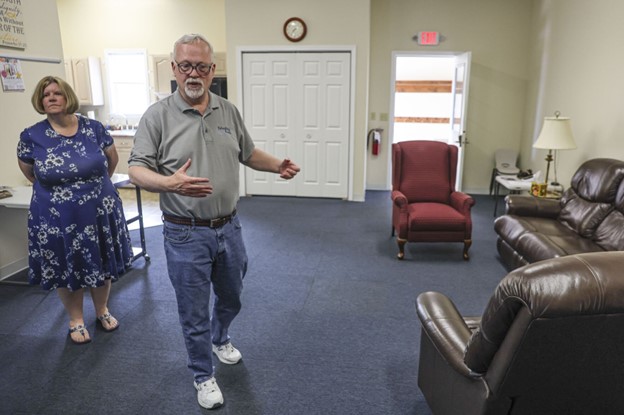
Luella, left, and Don Mahannah discuss the services offered at Integrity Counseling in Bloomington.
Reposted from The Pantagraph
Story by Olivia Jacobs, Photos by Clay Jackson & D. Jack Alkire
BLOOMINGTON — When Luella and Don Mahannah set out to open Integrity Counseling in 2014, they didn’t realize some of the same mental health barriers outlined in McLean County’s Behavior Health Action Plan and Community Health Improvement Plan would still exist today, but they aim to be part of the solution.
Integrity, a pay-as-you-can mental health service for those who are uninsured or underinsured, is one of several nonprofit organizations in McLean County working to support community members’ mental health needs for little to no cost.
Integrity’s mission is to provide “stigma-free mental health support for all.” Luella Mahannah, who has a master’s degree in counseling psychology, said when she was a volunteer at Home Sweet Home Ministries, she saw firsthand how difficult it was for people to receive counseling; even with insurance, people were waiting months to receive care, which inspired her to take action.
The Mahannahs recalled seeing former McLean County Sheriff Mike Emery speak on the news, during that time, about how the local jail had become a significant provider of behavioral health care because community members couldn’t get help elsewhere and were often ending up in jail.
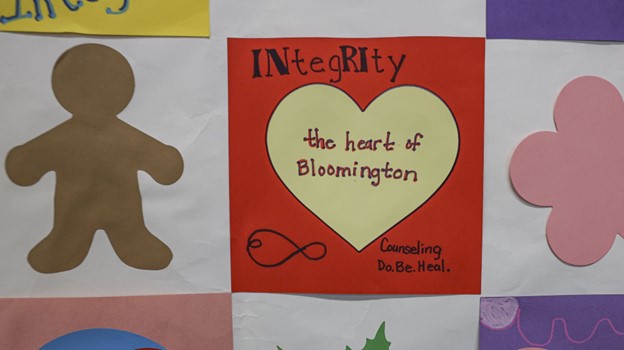
A quilt in the conference room created by Little Art School at Integrity Counseling.
“A lot of what our impetus has been trying to help people not slide into the justice system, stop that before. And so, we see lots of people (clients) who are on the edges of poverty,” Don Mahannah said. “A lot of times, people have insurance, but they can’t use it because the deductible is $5,000 and they’re choosing between groceries and counseling. And so, we’re trying to be that gap filler … being able to help people who wouldn’t otherwise get care.”
Their clients range from university students to those in other transitional periods of life, facing divorce, child issues, in-between employment and more. They range in age, income and gender. Some clients may pay nothing while others may pay $50 per session, depending on what they can afford. Integrity uses private donations and grants to help offset the costs, which they are always in need of to help further their services.
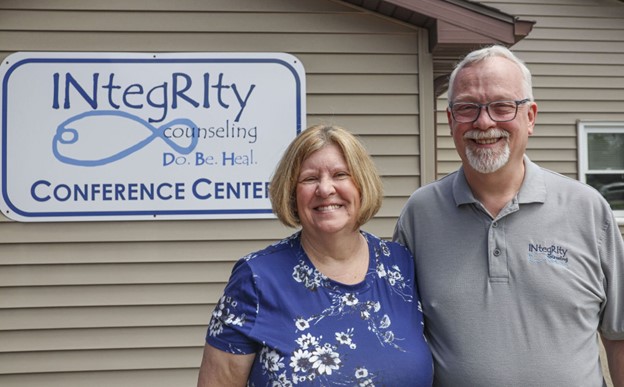
Luella, left, and Don Mahannah operate Integrity Counseling, a pay-as-you-can mental health service in Bloomington.
Integrity currently has two full-time counselors and one part-time as well as various volunteer counselors, with an active caseload of about 180 clients. They are always looking for more volunteers and interns, too, to help alleviate their waitlist, which is only about two to three people currently. Some of the staff and interns also see clients at the Boys & Girls Club of Bloomington-Normal, and the number of clients a counselor sees at a time often varies.
Luella Mahannah said they are taking on new clients. If someone calls in need of care, they are asked questions regarding income, insurance, whether they have tried to use insurance elsewhere and other topics. Once they have completed an intake appointment, new clients will be assigned a long-term counselor.
Integrity Counseling is open from 9 a.m. to 6 p.m. Monday through Thursday, 9 a.m. to noon on Fridays, and occasional Saturdays. They offer both in-person and telehealth services.
Integrity also works with local hospitals to schedule hospital discharge appointments and can schedule them within the same week a call is made. Additionally, they often have community members come to the center and teach on topics, like “Seven Habits of Highly Effective People” to help clients with various life skills.
Luella, left, and Don Mahannah operate Integrity Counseling, a pay-as-you-can mental health service in Bloomington.
“I think the model Integrity has could be replicated. I think other people could do what we’re doing. It’s a challenging thing to do, but I think that neighbors helping neighbors is a wonderful thing, and there are lots of resources,” Don Mahannah said of how we can further improve mental health resources locally. “Our process is unique, if you will, and we have a great partnership with other providers who will refer to us and we’ll refer back to them when it makes sense, so we try to be part of the fabric of behavioral health.”
‘Pathway to healing’
Another local nonprofit organization working to remove financial barriers for those in need of mental health services is the YWCA’s Stepping Stones program, the sexual assault service center for all of McLean County, which offers free services to assault survivors. Stepping Stones is a grant-funded program and also receives state and federal funding.
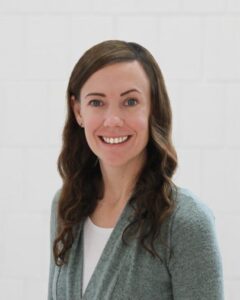
Jen Golliday
YWCA has five full-time counselors and one part-time counselor, with about 224 clients as of the end of March. They also have a 24-hour and year-round hotline people can call at 309-556-7000.
Program Director Jen Golliday has been with YWCA for eight years in many roles, including as a case manager, legal advocate and advocacy coordinator. She said Stepping Stones is accepting new clients, and the counselors are actively working through their waitlist.
Stepping Stones offers interim support for clients as they wait for a long-term counselor through advocacy services, including helping a client while they’re in the hospital, filing criminal charges or civil no-contact orders, connecting them with others who can offer additional support, informing them of their options and other general advocacy.
“There’s a lot of survivors who can’t afford therapy and might already be facing economic struggle. … Having an acceptable pathway to healing is just vital to the survivors themselves, their families and their community,” Golliday said. “I’ve gotten to see the impact on a day-to-day basis. … It’s almost hard to put into words. … A lot of the feedback we’ve gotten is we’re irreplaceable. (With Stepping Stones), you’re not having to walk this journey alone … and you can’t put a measure on that.”
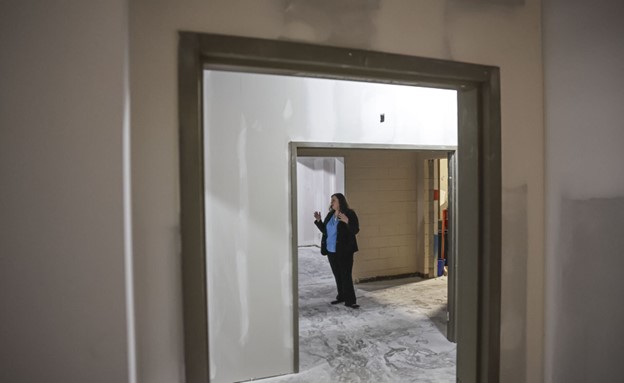
YWCA McLean County is renovating its space for Stepping Stones, its sexual assault support program, growing to meet the need for counseling and advocacy services, Liz German, president and CEO of YWCA, explains as she gives a tour.
She said people often forget that offering this kind of support helps strengthen the community overall, because when you support individuals you’re also supporting the community.
Additionally, YWCA offers prevention education for K-12 schools and at the college level to educate students on healthy relationships, how to listen to their bodies, learning to say “no,” ultimately trying to get ahead and prevent sexual violence before it occurs and what that can look like, Golliday said.
“It doesn’t matter when (the assault) occurred in your life — you are able to get services. Whether it was yesterday or 20 years ago, that has no bearing on whether you can get help,” she said.
‘Life changing’
One Hope Project, a mental health resource focused on eating disorder treatment, also offers low-cost care, using sliding scale for services.
Executive Director Hilary Pacha started the Bloomington-based nonprofit in 2020, having worked in the nonprofit field for more than 20 years. She said each client answers a question about their income range as part of the intake process. One Hope then provides a recommended rate per session and asks the client what they can afford. So if, for example, it suggests $50, but the client can afford $30, they’ll pay $30, Pacha said, noting One Hope has had clients pay as little as $5 per session.
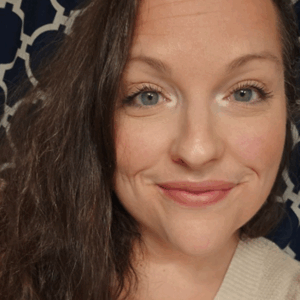
Hilary Pacha
She said in her early work, she met clients who were struggling with an eating disorder or body image issues, but there wasn’t a place to refer to them, unless they were seeking inpatient treatment at a hospital, which can be expensive and is usually a last resort.
This stuck with her over the years, especially as she found herself struggling with food addiction and body image issues of her own. Her heart was in nonprofit, so she didn’t want finances to be a barrier to someone in need of help, she said.
And while McLean County has several amazing nonprofit organizations, she said, there was a gap when it came to those specializing in eating disorder recovery.
One Hope has five counselors including eating disorder specialists and registered dieticians who offer nutritional counseling and basic case management as eating disorders usually don’t exist on their own. They also offer adult and teen support groups, and Pacha said they plan to bring their evidence-based research curriculum and prevention education into local schools. One Hope Project currently has 42 active clients with a small waitlist. They are currently training additional specialists.
“People don’t realize that eating disorders are a mental health concern,” Pacha said. “Eating disorders, you know, they don’t exist on their own, so there’s always a co-occurring mental illness, whether that’s anxiety, depression, some kind of trauma, maybe someone who’s on the (autism) spectrum … or OCD. … So, it’s like, of course, we need to work on the depression and the anxiety, … because that’s usually what is the forefront, but then underlying there is the eating disorder.”
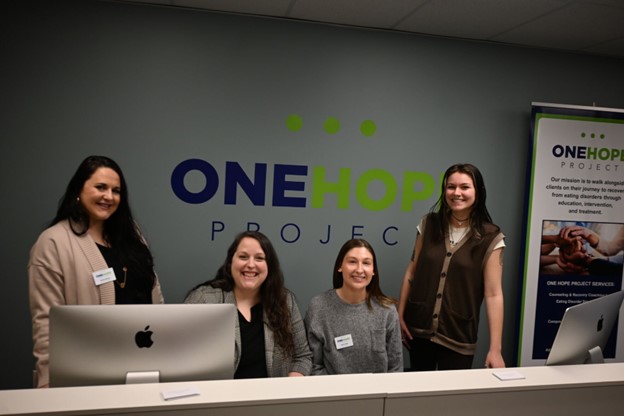
The staff at One Hope Project works to fight the stigma around eating disorders and helping people affected by them. Pictured from left to right are Jenna Salinas, Hilary Pacha, Sierra Abel and Kamryn Loyd.
Pacha said eating disorders have the second highest mortality rate of mental illnesses behind opioid addiction, with someone dying every 52 minutes, yet it receives less than 1% of federal funding. According to the National Eating Disorders Association, approximately 20 million women and 10 million men will experience an eating disorder in their lifetime, and Pacha said the people suffering from eating disorders in McLean County could fill CEFCU Arena one-and-a-half times.
One Hope is always looking for more registered dieticians and volunteers to become eating disorder specialists to avoid a long waitlist. The organization offers specialist training, as experience is not required.
Randi Maas of Bloomington, a client of One Hope since 2023, said raising six kids and college bills were a barrier to affording one-on-one counseling to help with her struggles with food addiction and emotional eating.
“I don’t know how many times I asked the doctors and said ‘I know I have a food addiction; is there a nutritionist in town, somewhere I can go,’” she said.
Usually the response she received was along the lines of simply “eat less, move more,” she said.
By chance, she learned about One Hope through a volunteer, and “I go ‘oh, I think I need that,’” Maas said.
Maas said it’s been exciting to see her health changes, including no longer being considered pre-diabetic.
“It’s been life changing and just the tools they give you to make progress … I can’t imagine life without One Hope,” Maas said.
Pacha said one of her favorite things she ever heard from a client was: “You know, after working with you all and kind of getting to that place I needed … I now know why you call it One Hope. … For the first time, I actually have hope.”
Illinois Prairie Community Foundation awarded General Grants to Integrity Counseling and One Hope Project to help fund their mental health programs. If you would like to support mental health, donate online. IPCF’s Women to Women Giving Circle awarded a grant to the YWCA to provide support to women attending counseling. If you would like to support programs for women and children, donate online.